

Written by Kaylee Garza, licensed home inspector and real estate agent.
Original research1 from residential home inspections in the Oklahoma City metro.
It’s brand new.
Nobody has lived in it. The appliances are new. The roof is new. The HVAC system is new. The builder had permits. The house went through municipal inspections. So why would you pay for another inspection?
It’s a reasonable question.
And based on the data from the analyzed inspections, newer homes really did have fewer inspection findings.
But fewer findings and no important findings turned out to be two very different things.
New homes had dramatically fewer findings
127 Oklahoma City-metro home inspection data1 were analyzed, and the number of actionable findings varied between ages of homes. The difference was quite substantial, however, predictable.
Homes built before 1980 averaged 23.7 actionable findings per inspection while homes built in 2020 or later averaged just 10.7.
That’s less than half as many. At least in this sample, newer homes had substantially fewer findings. That’s good news for new-construction buyers.
But then I isolated the newest homes in the dataset and that’s where things got interesting.
I looked specifically at homes built in 2025
There were 12 homes built in 2025 in the inspection dataset. That’s a small sample, and that’s important. Twelve houses are nowhere near enough to estimate how frequently serious defects occur across all new construction in Oklahoma City.
But they do give us an interesting opportunity.
These weren’t 20-year-old houses with aging roofs, deteriorating equipment and decades of homeowner repairs.
They were brand-new homes.
Across those 12 inspections, inspectors documented 125 actionable findings.
That’s an average of about 10.4 findings per house.
But the number of findings wasn’t the part I found most interesting.
I wanted to know:
How important were they?
Measuring priority instead of simply counting defects
For this research, I developed a 0–10 Priority Index to help distinguish routine inspection observations from conditions deserving greater attention.
The index considers three components:
- Safety and functional consequences; 50%
- Potential financial exposure; 30%
- Level of professional or regulated-trade intervention; 20%
A loose fixture, for example, shouldn’t receive the same weight as an active gas leak simply because they each occupy one line in an inspection report.
For this analysis, I treated findings reaching 7.0 or higher as high-priority findings.
Then I asked a very simple question:
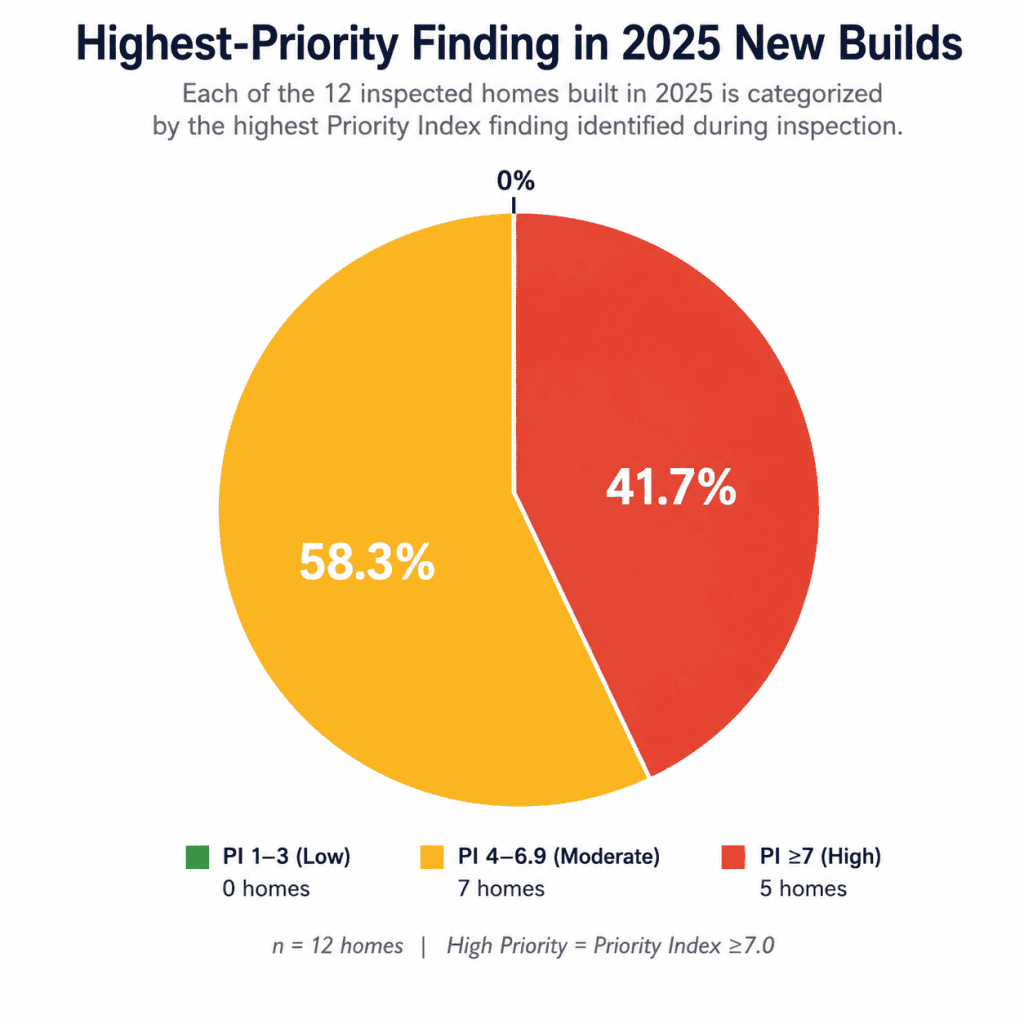
How many of the 12 homes built in 2025 contained at least one of those findings?
The answer surprised me.
5 of 12 new homes had at least one high-priority finding
Among the 12 homes built in 2025, five contained at least one inspection finding reaching 7.0 or higher on the study’s Priority Index.
That’s 41.7% of this small 2025 sample.
Now, here’s the part where statistics need to be handled responsibly.
That does not mean:
“41.7% of new homes in Oklahoma City have serious defects.”
We cannot make that claim from 12 houses.
What we can say is:
In this sample of 12 homes built in 2025, 41.7% contained at least one finding that reached the study’s high-priority threshold.
And the actual conditions behind those scores matter much more than the percentage itself.
What were inspectors actually finding?
Four of the five high-priority homes had something particularly noteworthy:
An active gas leak.
Gas leaks were identified at locations involving water-heater piping, furnace-area gas piping, and near a gas meter.
Another 2025 home had a furnace condensate drainage problem in which water was accumulating around electrical components. The inspection report specifically identified the condition as presenting a potential shock hazard and recommended further evaluation and repair by an HVAC professional.
One of the homes with a gas leak also had a cracked rafter near the ridge that was reported as reducing the member’s load capacity.
These weren’t observations caused by 30 years of deterioration.
They were conditions identified in homes built that year.
And that distinction matters.
New construction defects are different from old-house defects
An older house has had decades for things to happen.
Materials deteriorate. Equipment reaches the end of its useful life. Foundations move. Plumbing corrodes. Homeowners perform questionable DIY repairs. Roofs weather. Components get modified.
A new house hasn’t had that history.
Many of its deficiencies are more likely to involve installation, workmanship, adjustment, completion or construction-related issues rather than age-related deterioration.
That’s actually one of the biggest reasons I think new-construction inspections make sense.
You’re not necessarily hiring an inspector because you expect the house to be worn out.
You’re hiring one because new doesn’t guarantee correctly installed.
But didn’t the city already inspect it?
Yes, new construction typically goes through required municipal inspections.
But a municipal code inspection and a private home inspection serve different purposes.
Code officials are performing their role within the permitting and code-enforcement process.
A home inspector is evaluating the property on behalf of the client and documenting observable conditions across the home’s systems and components within the scope of the inspection.
Those processes aren’t interchangeable.
And the fact that a house received approvals during construction doesn’t mean there will be nothing for a private inspector to find.
The 2025 homes in this dataset are a pretty good demonstration of that.
Ten findings aren’t necessarily worse than three
There’s another lesson buried in these numbers.
Imagine two brand-new houses.
House A:
The inspector documents 15 relatively minor deficiencies.
House B:
The inspector documents five deficiencies, but one is an active gas leak.
Which inspection report concerns you more?
Simply counting findings can’t answer that question.
That’s why one of the biggest themes to emerge from this entire research project was:
The number of inspection findings tells us something about a home’s condition. It doesn’t necessarily tell us how consequential those findings are.
New homes had fewer findings overall.
Yet some of those homes still contained individual conditions with meaningful safety or functional consequences.
Both things can be true at the same time.
So, should you inspect a brand-new house?
Based on this dataset, yes, I would.
Not because every new house is riddled with defects.
The data actually suggests the opposite: newer homes in this sample had substantially fewer actionable findings than older homes.
I’d inspect it because the consequences of the defects that do exist aren’t determined by the age printed on the property record.
A loose door adjustment is minor whether the house is six months old or sixty years old.
An active gas leak deserves attention whether the house is six months old or sixty years old.
That’s the distinction buyers should care about.
New doesn’t mean bad. New doesn’t mean perfect either.
I don’t think home inspectors do buyers any favors by portraying new construction as terrible.
The homes built in 2020 or later in this dataset performed substantially better in terms of the number of findings than older homes.
That’s worth acknowledging.
But the 2025 inspections also demonstrate why “brand new” shouldn’t be treated as a substitute for “inspected.”
A good inspection isn’t about finding enough things wrong with a house to justify the inspection fee.
It’s about identifying the things that are there, putting them into context, and helping a buyer understand which ones actually matter.
1About the data
This analysis is part of a study of 127 residential home inspections in the Oklahoma City metropolitan area collected by Greg Crews owner of Pi Property Inspections. Thank you for the kind donation! OKC Property Chick efforts in this study remained solely with data collection assistance, organization, and communication. This remains a collaborative, joint effort!
The priority index is not an Oklahoma regulatory rating, engineering determination, repair-cost estimate, or substitute for professional evaluation of an individual property. It is not affiliated with Pi Property Inspections.

Hi, this is a comment.
To get started with moderating, editing, and deleting comments, please visit the Comments screen in the dashboard.
Commenter avatars come from Gravatar.