
Written by Kaylee Garza, retired scientist, licensed home inspector.
Your air conditioner doesn’t actually make cold air. It’s a heat thief….it steals it from inside your house and dumps it outside. Once you understand these basics, AC maintenance becomes a lot less daunting and more manageable (and those inspection findings start to make a little more sense).
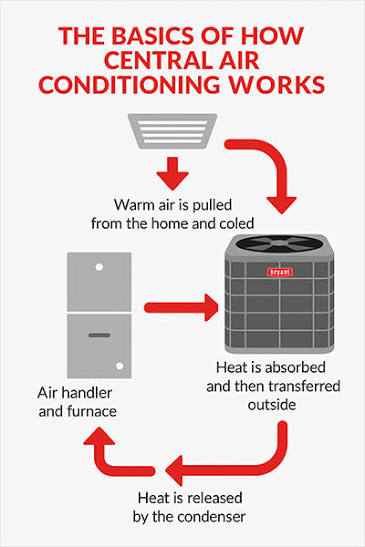
Step 1: Your AC steals heat from inside your house
Inside your air handler/furnace/air yeeter is the evaporator coil, basically a bunch of small metal loops.
Cold refrigerant (less than 40 df) moves through these coils while warm air from your house blows across them. Warmth naturally wants to move from warmer to cooler states, so the heat transfers through the evaporator coils in to the refrigerant. Since we can practically boil any liquid at any temperature if the pressure is low enough, the refrigerant boils at 40 df, and it turns from a liquid to a vapor.
Meanwhile, the air travels through your ducts, exits the supply registers, and feels a bit cooler after the heat transfer.
What do we do with all the heat we just stole from your house?
It’s escorted outside.
Step 2: The refrigerant carries that heat outside
That refrigerant travels back toward your outdoor unit through the big insulated copper line you see connected to your condenser.
That’s called the suction line.
And yes, there’s a reason it’s insulated. We will get to that in a second.
Step 3: The compressor squeezes the refrigerant
Now the refrigerant gets to the compressor.
The compressor …you guessed it…compresses the refrigerant vapor. It basically shoves the vapor into a smaller space. Smaller space -> higher pressure -> higher temperature. And NOW the refrigerant is hotter than Oklahoma. Since warmth naturally transfers to cooler states…. warmth transfers to the great outdoors, cooling the refrigerant.
Step 4: Now we can dump the heat outside
That hot refrigerant moves through the outdoor condenser coil.
The fan pulls outdoor air across the coil, and heat transfers from the hotter refrigerant into the cooler outdoor air.
That’s why the air blowing out of the top of your condenser feels hot.
That’s your house’s heat.
As the refrigerant rejects heat, it condenses into a high-pressure liquid.
It then heads back toward the house, passes through a metering device that drops its pressure, becomes cold again, and returns to the evaporator coil.
Then it steals some more heat.
Over.
And over.
And over.
And over.
That’s air conditioning.
So how do you keep your AC working?
Once you understand an AC is a heat uber, AC maintenance gets a lot easier to understand.
Most of what your system needs comes down to one thing:
Let it move heat and air the way it was designed to.
Here are a few of the problems I commonly see.
1. Dirty condenser fins
Those little metal fins surrounding your outdoor condenser aren’t just there to look pretty.
They give the system a huge amount of surface area to get rid of heat.
Air needs to be able to move across them.
When those fins get packed with dirt, grass clippings, cottonwood, leaves and Oklahoma’s general collection of airborne nonsense, you’re basically putting a blanket over something that’s trying to get rid of heat.
The system can still run.
It just has to work harder to accomplish the same job.
What to do: Keep vegetation and debris away from the condenser and have dirty coils cleaned appropriately. Be careful with pressure washers…the fins are thin and easy to damage. I suggest using a garden hose, or a fin-approved cleaner for pesky, stubborn material….like pet dander.
2. Missing insulation on the big refrigerant line
OK NOW we can talk about why that suction line is wrapped in a pool noodle. The refrigerant inside that line is cold. If we leave cold copper sitting in hot climate (I’m looking at YOU Oklahoma), heat is going to transfer back into it. More heat -> more pressure -> compressor works overtime, decreasing efficiency and possibly its life.
Insulation also helps prevent condensation from forming on the cold pipe (annoying). But if you’re line is in the attic, that condensation can damage decking, floor joists, and/or drywall (more annoying).
What to do: Replace deteriorated or missing insulation with insulation intended for refrigerant lines.
3. A dirty air filter
Your AC needs airflow on both sides of the system.
Outside, air has to move across the condenser coil to release heat.
Inside, air has to move across the evaporator coil so the refrigerant can absorb heat.
A heavily clogged filter restricts that airflow.
That can reduce performance and contribute to problems like the evaporator coil becoming too cold and eventually freezing… like actually freezing.
So yes, the boring little filter you keep forgetting about actually matters.
What to do: Check it regularly and replace it as needed. How often depends on the filter, your system, pets, dust levels and how much the equipment runs. I have 2 cats…so I replace mine monthly.
4. A clogged condensate drain
Remember that cold evaporator coil?
It doesn’t just remove heat.
It also removes moisture from your indoor air, decreasing humidity.
Water condenses on the evaporator coil, falls into a drain pan, and leaves through the condensate drain.
If that drain becomes clogged with sludge or biological growth, the water still has to go somewhere.
Unfortunately, “somewhere” can become the equipment cabinet, ceiling, floor, attic or mechanical closet. Text me, and I can give you a pic of the sludge ball I recently pulled out of my HVAC unit…
What to do: Have condensate drainage maintained and investigate water around HVAC equipment instead of assuming it’s normal AC condensation.
5. Damaged condenser fins
Dirty fins restrict heat transfer.
Bent or crushed fins can restrict airflow too.
A few bent fins aren’t necessarily a major issue. But widespread damage reduces the effective area available for airflow and heat exchange.
This is one reason blasting the condenser with a pressure washer is not my favorite DIY maintenance strategy.
You’re trying to clean the heat exchanger.
Not waterjet it into another dimension.
6. Don’t suffocate the outdoor unit
Your condenser needs access to outdoor air.
Bushes growing against it, weeds surrounding it, stored items leaning against it or other obstructions can restrict airflow.
And now that you know what the condenser’s job is, you know why that’s a problem.
It’s trying to dump your house’s heat outside.
Give it some room.
The easiest way to think about your AC
You don’t have to understand refrigerant pressures or become an HVAC technician to take better care of your system.
Just remember:
Inside coil: picks up heat.
Refrigerant: carries the heat.
Compressor: raises the refrigerant’s pressure and temperature.
Outside coil: gets rid of the heat.
Airflow: makes the entire process possible.
So when something is dirty, clogged, blocked, leaking or poorly insulated, ask yourself:
Is this making it harder for the system to move heat?
A surprising amount of basic AC maintenance makes sense once you look at it that way.
And in an Oklahoma summer, I’d prefer not to make my AC’s job any harder than it already is.